If you are setting up a telephone system for an office in Bangladesh, choosing the right PABX system depends mainly on the number of employees, required extensions, outside telephone lines, expected call volume, and whether you need traditional telephone lines or IP/SIP connectivity.
For a small office, an analog or hybrid PABX can be a practical choice. For a growing company with remote users, multiple branches, SIP trunks, or IP phones, an IP PABX or hybrid IP PABX may be more suitable.
Telecare currently supplies PABX systems from brands including Panasonic, IKE, Miracall and TCS, with systems ranging from small office solutions to high-capacity enterprise platforms.
Quick Answer: Which PABX Is Best for an Office?
There is no single PABX that is best for every office.
A useful starting point is:
| Office Size |
Typical Requirement |
Recommended PABX Type |
| 5–10 users |
Basic internal communication |
Small analog PABX |
| 10–20 users |
Multiple extensions + outside lines |
Analog/Hybrid PABX |
| 20–50 users |
Expansion + advanced features |
Hybrid or IP PABX |
| 50–100 users |
Higher call volume + scalability |
IP/Hybrid PABX |
| 100+ users |
Multiple departments/branches |
Enterprise IP PABX |
| Hotel/Factory/Hospital |
Large extension network |
High-capacity hybrid/IP PABX |
The important point is that employee count alone should not determine PABX capacity. You also need to consider how many telephones, outside lines, concurrent calls and future extensions you expect.
What Is a PABX System?
A PABX (Private Automatic Branch Exchange) is a business telephone system that connects multiple internal extensions and allows them to share external telephone lines.
For example, an office with 20 employees might have 20 internal extensions but only a few outside telephone lines. Instead of providing an individual external telephone line to every employee, the PABX manages the shared lines.
A PABX can provide features such as:
- Internal extension-to-extension calling
- Call transfer
- Call hold
- Call forwarding
- Incoming call distribution
- Outgoing line selection
- Conference calling
- Auto attendant/DISA on supported systems
- Caller ID on compatible systems
- Extension restrictions
- Different calling permissions
This makes PABX systems particularly useful for offices, factories, hotels, hospitals, educational institutions and other organizations with multiple employees.
How to Choose the Best PABX for Your Office
Before buying a PABX, answer these six questions.
1. How Many Employees Need Telephone Extensions?
First determine how many people need individual extensions.
For example:
- 8 employees → around 8 extensions
- 16 employees → around 16 extensions
- 30 employees → around 30 extensions
- 50 employees → around 50 extensions
However, don’t automatically purchase a system with exactly the number of current employees.
If your business is growing, leave room for additional extensions.
Example: If you currently have 14 employees but expect to reach 20–24 employees within the next few years, a system expandable beyond 14 extensions may be a better investment.
2. How Many Outside Lines Do You Need?
The next question is how many external telephone lines your office uses.
Suppose you have:
- 20 employees
- 20 internal extensions
- 4 external telephone lines
You don’t necessarily need 20 outside lines.
The PABX allows employees to share those external lines according to your company’s calling requirements.
This is one of the major benefits of a PABX system.
3. Do You Need Analog, Hybrid or IP PABX?
This is one of the most important purchasing decisions.
Analog PABX
Analog PABX systems are suitable when your office primarily uses conventional telephone lines and standard analog telephone sets.
They are generally attractive for:
- Small offices
- Shops
- Small businesses
- Simple intercom systems
- Cost-conscious installations
Hybrid PABX
Hybrid systems can support different types of telephony technologies depending on the model and installed cards.
They can be useful when a business wants to maintain existing telephone infrastructure while adding more advanced communication options.
IP PABX
IP PABX systems use IP networks for telephone communication and can support features such as IP phones, SIP trunks, remote extensions and software-based phones, depending on the system.
They are particularly useful for:
- Growing companies
- Multi-branch businesses
- Remote employees
- SIP/VoIP users
- Businesses wanting IP phones
- Organizations requiring easier expansion
Best PABX for a Small Office in Bangladesh
For a small office, you generally don’t need an expensive enterprise telephone system.
A small business may need:
- 4–16 extensions
- 1–4 external lines
- Internal calling
- Call transfer
- Call hold
- Basic caller ID
- Simple administration
- Affordable telephone sets
An analog PABX can therefore be a practical option.
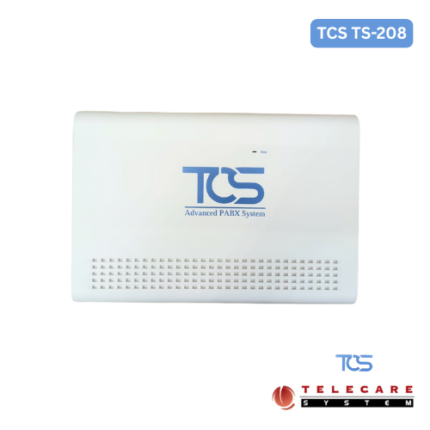
For example, Telecare’s PABX range includes small-capacity systems such as the TCS TS-208 PABX, which is listed with support for 8 lines and features including call transfer and intercom functionality.
The correct model, however, should be selected according to the actual line and extension requirement rather than simply choosing the cheapest machine.
Best PABX for a Medium-Sized Office
A medium-sized business may require:
- 20–50 extensions
- Multiple outside lines
- Call transfer
- Caller ID
- Automated call handling
- Expansion capability
- Better administration
- Potential IP integration
At this stage, a hybrid or IP PABX can make more sense than a basic analog system.
The main advantage is scalability.
You may start with 20 or 30 users and later expand the telephone network as the business grows.
Best PABX for a Large Office
Large organizations often have very different requirements.
A factory, hospital, hotel, university or corporate office may require hundreds of extensions across multiple departments.
For example, Telecare lists the Panasonic KX-TDA600 as a high-capacity hybrid IP-PBX platform designed for large organizations, with support for analog, digital and IP telephony depending on configuration. Its typical applications include factories, hotels, universities, hospitals and larger corporations.
For this type of project, simply asking for the “cheapest PABX” is usually the wrong approach.
The system should be selected based on:
- Number of extensions
- Number of trunks
- Telephone types
- IP requirements
- Future expansion
- Department requirements
- Call volume
- Existing cabling
- Required features
- Installation and maintenance requirements
Panasonic PABX: Is It a Good Choice for an Office?
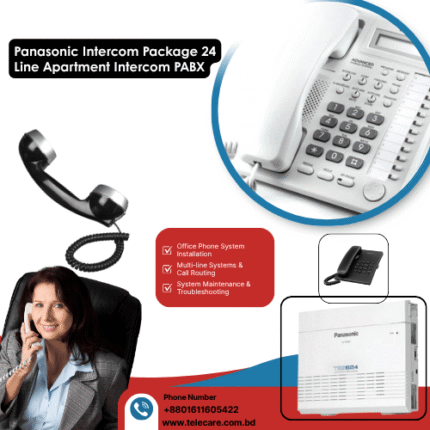
Panasonic pabx is one of the major PABX brands available in the Bangladesh market.
Telecare currently lists Panasonic systems including models such as the KX-TES824, KX-TDA100D and KX-TDA600.
For example, the Panasonic KX-TES824 starts as a 3-line/8-extension system and can be expanded up to 8 CO lines and 24 extensions with the appropriate expansion configuration.
This type of expandable design can be useful for a small or medium business that expects its telephone requirements to increase.
However, Panasonic is not automatically the best choice for every office.
The right choice depends on your:
budget + capacity + telephone type + features + future expansion + external line requirements.
What Telephone Set Should You Use With a PABX?
The telephone set must be compatible with the type of PABX extension.
For standard analog PABX extensions, a suitable analog telephone can often be used.
For proprietary digital extensions, you may need a compatible proprietary telephone designed for that particular PABX platform.
For IP PABX, you generally need compatible IP phones or software/softphone solutions depending on the system.
For example, Telecare lists Panasonic telephone sets such as the TS-101, which uses a standard RJ11 connection and supports PABX-related functions such as timed flash for call transfer and hold.
So don’t purchase the telephone first and assume it will work with every PABX.
Always confirm the extension type and compatibility before buying.
How Much Does a PABX Cost in Bangladesh?
PABX prices in Bangladesh vary significantly according to:
- Brand
- Number of extensions
- Number of outside lines
- Analog vs digital vs IP
- Expansion capability
- Features
- Accessories
- Installation
- Configuration
Current Telecare listings show basic PABX systems starting around ৳3,000, while larger enterprise systems can cost ৳3,00,000 or more, depending on configuration.
For example, Telecare currently lists the Panasonic KX-TES824 at around ৳33,000, while larger Panasonic systems are priced considerably higher.
Because PABX pricing can change with stock, configuration and expansion cards, businesses should request a quotation based on their exact requirements rather than relying only on a generic price.
PABX Requirements Example for a 20-Person Office
Suppose you have a company with:
- 20 employees
- 20 required extensions
- 4 external telephone lines
- 1 receptionist
- Expected future growth to 25 users
A suitable system should ideally provide:
20+ extensions + 4 external lines + expansion capability.
You should also decide whether the receptionist requires a dedicated operator telephone, whether caller ID is required, and whether you plan to introduce IP phones or SIP later.
This is much more useful than simply searching for “20 extension PABX.”
Should You Buy a Cheap PABX?
Not necessarily.
The cheapest PABX may be suitable for a simple office, but it can become expensive if you later need to replace the entire system because:
- Extensions are insufficient
- No expansion slots are available
- IP integration isn’t supported
- Required features aren’t available
- Compatible telephone sets are difficult to source
- Technical support is unavailable
For a business telephone system, total cost of ownership is more important than the initial purchase price.
A slightly more expandable system can sometimes be the better investment.
7 Things to Check Before Buying a PABX in Bangladesh
1. Extension Capacity
Make sure the system supports your current and future users.
2. External Line Capacity
Check how many PSTN, GSM, SIP or other trunks are required.
3. Telephone Compatibility
Confirm whether your existing telephone sets can be used.
4. Expansion
Ask whether additional extensions or trunk cards can be added later.
5. Power Protection
Bangladesh businesses should consider power quality, surge protection and backup power requirements.
6. Installation & Programming
A PABX is not simply a plug-and-play telephone accessory. Correct wiring, programming and configuration are important.
7. After-Sales Support
Check whether the supplier can provide programming, repair, expansion and technical support after installation.
PABX Buying Checklist for Bangladesh Businesses
Before ordering, prepare this information:
- Number of employees: ___
- Required extensions: ___
- External telephone lines: ___
- PSTN/BTCL lines: ___
- GSM requirement: Yes/No
- SIP/VoIP requirement: Yes/No
- IP phones required: Yes/No
- Current telephone sets: ___
- Expected future extensions: ___
- Call recording required: Yes/No
- Auto attendant/IVR required: Yes/No
- Remote extensions required: Yes/No
- Installation required: Yes/No
Once these requirements are known, selecting the correct PABX becomes much easier.
Frequently Asked Questions
Which PABX is best for a small office?
A small office usually benefits from a compact analog or hybrid PABX with enough extensions and external lines for current requirements plus some room for expansion.
Which PABX is best for 20 users?
For around 20 users, choose a system that supports at least 20 extensions and provides the required number of external lines. A hybrid PABX can be useful if future expansion or additional telephony technologies are expected.
Is Panasonic PABX good for office use?
Yes. Panasonic offers PABX platforms covering small, medium and large business requirements. The appropriate model depends on the required extension capacity, trunks, telephone types and features.
What is better: analog PABX or IP PABX?
Analog PABX can be practical for simple and cost-sensitive installations, while IP PABX is generally more flexible for businesses requiring IP phones, SIP, remote extensions or multi-location communication.
Can I use a normal telephone with PABX?
A standard analog telephone can generally be used with a standard analog PABX extension. However, proprietary digital PABX extensions require compatible digital telephone sets. Always check the PABX documentation before purchasing.
How many extensions should I buy for my office?
Start with the number of employees who actually need a telephone, then add capacity for expected growth. Buying a system with no expansion capacity can create problems later.
How much does PABX installation cost in Bangladesh?
Installation cost depends on the number of extensions, cable length, system complexity, programming and site conditions. A supplier should provide an installation quotation after understanding the project requirements.
Final Recommendation
For most Bangladesh businesses, the best PABX is not necessarily the most expensive or the cheapest model.
Choose according to:
Number of users → extensions → external lines → telephone type → required features → future expansion → IP/SIP requirements → installation → after-sales support.
For a small office, a basic analog PABX may be sufficient. For a growing organization, a hybrid system can provide a useful transition path. For businesses requiring IP phones, SIP, remote users or multiple locations, an IP PABX is often the more flexible approach.
If you’re unsure which system fits your office, prepare your number of employees, required extensions, external lines and preferred telephone type and request a system recommendation rather than purchasing based only on price.
Telecare System currently supplies PABX machines and telephone sets in Bangladesh, including Panasonic, IKE, Miracall and TCS systems, with product and installation support.